
Print on Demand Pricing: Building a Margin That Survives Discounts and Ads
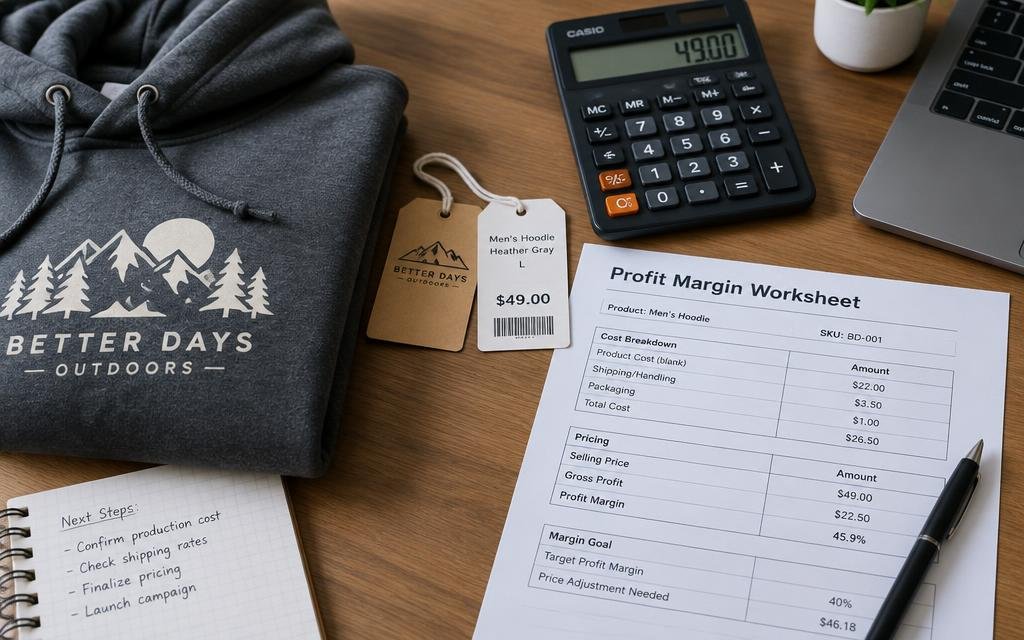
Count every cost before setting a price
Base product cost, printing, shipping, platform transaction fee, payment processing, currency conversion, the occasional reprint and, if you advertise, your cost per acquisition. Sellers routinely price against the base cost alone and discover months later that the business never made money. Build the full list once in a spreadsheet and reuse it for every product.
Target margin, not markup
Aim for at least forty percent gross margin on print on demand, because returns, reprints and advertising will eat into it. A twenty percent margin leaves no room for a single promotion. If the numbers do not reach forty, either the product is wrong, the supplier is wrong, or the niche will not support a price you can charge.
Shipping strategy changes perceived price
Buyers respond better to a higher item price with free shipping than to a low price plus a shipping charge added at checkout. Build shipping into the price where your platform allows, and be consistent across the catalogue so repeat customers are not surprised.
Price by niche willingness
A hobby with expensive equipment supports higher prices than a general-interest joke. Professional and occupational niches pay more, because the purchase feels like an identity investment rather than a novelty. The same design can support quite different prices in two different niches; test rather than assume.
Bundles and multi-buy
Offer a two-item or family set at a modest saving. Because the marginal cost is a second base unit rather than a second acquisition, the profit per order rises even at a discounted rate. Gift-driven niches respond particularly strongly to sets.
- Include every fee in the cost base
- Target 40%+ gross margin
- Fold shipping into the price
- Charge more in professional niches
- Use sets to raise order value
Discounting deliberately
Blanket sales every month teach buyers never to pay full price. Run promotions with a real reason and a real end, and prefer value-adds — a free digital extra, a bundle upgrade — over percentage cuts, because value-adds protect the margin you worked to build.
Review costs quarterly
Suppliers raise base prices, shipping rates change and platform fees move. A price set two years ago may now be unprofitable. A quarterly review of your cost sheet takes half an hour and occasionally saves a product line from quietly losing money all year.
Know your break-even per product
For each item, calculate how many units must sell to cover the design time you invested. It is a sobering number and an extremely useful one: it tells you when to stop supporting a design, and it makes the case for reusing a proven design across several products rather than starting fresh each time.
Skip the blank page. Browse the shop for instant downloads.
Browse the shop