
Snowshoe Hiking Log Printable: Remember Every Winter Hike
Snowshoe hiking log printable: Making sense of a snow-filled season
If you’ve ever woken up sore after a winter hike and tried to piece together which trail left you aching—or wondered which route had the magical fresh powder—you’re not alone. Snow tends to smooth out details, and after a month of hiking, memories of “that one pretty valley” and “that day it was icy all the way up” start to tangle together. Whether you’re out snowshoeing before work, hiking every Saturday, or making the most of a single snowstorm, it’s easy to lose track of what worked, where you found packed trails, and which loops left you yearning for an extra pair of wool socks. That’s why having a snowshoe hiking log printable isn’t just about organization. It’s about remembering the small but important details that shape your winter adventures, so next year’s season is even better.
Why use a snowshoe hiking log printable instead of just “remembering”?
Most people—including me—start the season with good intentions: “This year, I’ll actually keep track.” But without some kind of log, it’s all too easy to forget if you did 4.5 or 6 miles last Saturday, or if Pine Hollow was the spot with endless packed powder or that unexpectedly steep patch. Say you head out to three different trails in a week: Monday at Buckhorn Loop, Wednesday at Willow Marsh, Saturday at Star Ridge. By February, you’re flipping through phone photos, half-remembering which was windblown, which was sunny, and which one had that sneaky hill that almost made you turn around. A snowshoe hiking log printable means you can reach for a clear, handwritten record. I’ve found that sitting in the car and jotting a few lines—distance hiked, snow depth, trail name—makes it stick.
Printable logs also don’t run out of battery, and they don’t ask for cell service. You can bring a few sheets on every outing, tucked into a zip bag or stashed in your daypack. Personally, I’ve given up on relying on my phone’s notes app after too many cold-weather touchscreen fails. Paper plus pen just works—especially when your gloves are caked with snow.
What to record: Making your snowshoe log useful (not a chore)
If you want your snowshoe hiking log printable to actually help you (and not become busywork), it’s worth deciding what you’ll really use. Overcomplicating things leads to blanks and forgetfulness. Here’s a simple set of fields I recommend, with a nod to how each serves your hiking memory:
- Date: Simple, but seeing the rhythm of your hikes over the season—say, how January was all heavy snow, then March melted fast—helps you predict next year’s patterns.
- Trail/Area: Get specific. Instead of “south woods,” write “Bluebird Trail, north loop.” It’s the difference between a useful log and a stack of vague notes.
- Distance and Elevation: Whether you hike 1 mile or 6, this lets you compare effort and see progress over time. Maybe you realize the “short loop” actually isn’t that short after all.
- Snow Depth & Conditions: Did you slog through powder, skate over ice, or cruise on firm packed snow? Noticing these trends helps for picking gear next time. Record “12-inch powder, drifting” versus “hardpack, 2 inches.”
- Weather: I like to note “flurries, 18°F, light wind”—because a loop that’s peaceful at 25°F can be a slog at 10°F in a stiff breeze.
- Notes: Anything worth remembering—animal tracks, stream crossings, gear surprises (“gaiters needed after new snowfall”), or the day you lost a glove at mile 2.
If you’re a minimalist, just the top four might do. If you’re hiking with kids, maybe the notes become drawings or quick sketches. The point is: don’t let perfectionism keep you from writing anything at all.
Turning your snowshoe hiking log printable into a real habit
The hardest part isn’t printing the log. It’s remembering to fill it out every single time. I’ve tried a lot: apps, fancy notebooks, even audio memos (not recommended unless you like listening to yourself panting at the trailhead). The printable works best when it’s visible and handy. Here are a few things that help turn logging into a real, repeatable winter habit:
- Store it in your daypack—always. Not at home. Not in the car—unless you park right at the trailhead. A zip bag works for protection from snow and damp gloves.
- Fill it out right after your hike, before you drive off. If you wait until home, details blur. I keep a cheap pen clipped to the bag for cold hands.
- Make a mini ritual. For me, jotting a few notes while sipping tea in the car is the finish line. Maybe yours is while your buddies take off their snowshoes. Habit grows from cues like this.
- Don’t worry about handwriting. It’s not getting graded. Just legible enough for your future self.
- Display your filled logs. I pin mine to a cork board in the mudroom—it’s an odd little trophy wall, and it reminds me that even tough winter days added up to something.
Think you’ll forget? I sometimes tape a blank log to my water bottle as a reminder. If all else fails, a big sticky note on your gear bag or fridge isn’t too subtle to work.
Step-by-step: How to use your snowshoe hiking log printable, start to finish
- Download and print several copies: Use US Letter or A4 paper, whatever fits your printer. I always print 5-6 at the start of the season to avoid excuses.
- Protect your log: Slip a page into a plastic sleeve, freezer bag, or weatherproof pouch—especially if you’re snowshoeing in wet snow or with young hikers who like dropping things.
- Fill in the basics before you start: Jot the date, trail name, and planned distance at home or in the car while you’re gearing up. It’s easier to get the details while you’re still fresh.
- Pay attention during your hike: Take mental notes about snow depth, trail surface, and views. I sometimes make a quick tick mark on the log mid-hike if something stands out (“stream crossing icy, mile 1.5”).
- Complete the rest right after finishing: Before you change your boots, log the snow conditions, weather, distance actually covered, and any surprises (like that spot where your pole post-holed shoulder-deep).
- Store filled logs together: I keep finished pages in a binder or folder at home. Some people dedicate a section on a bulletin board or tape them to the inside of a closet door.
- Review your logs occasionally: At mid-season or before planning the next hike, flip through your old entries. You’ll spot patterns (“South Ridge always icy after storms,” or “West Loop best right after fresh snow”).
- At season’s end, tally your stats: Add up miles hiked, trails explored, or days out. Even if you skipped a week (or three), seeing the record is surprisingly motivating for next season.
A closer look: The printable snowshoe hiking log from DigitalByVB
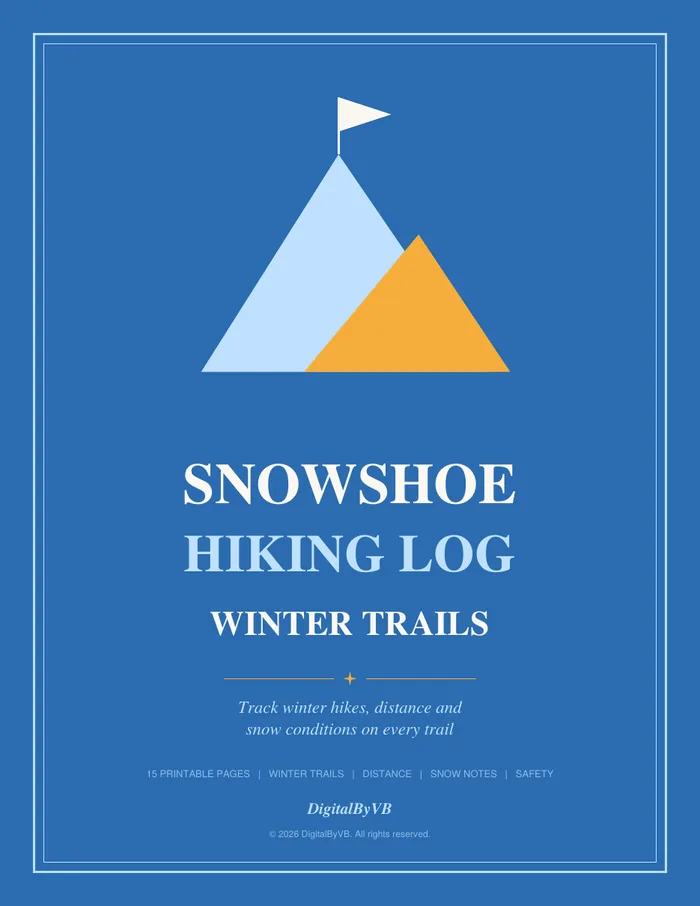
If you want a ready-to-go, no-fuss option, check out the Snowshoe Hiking Log Printable from our shop. It’s a simple, fuss-free PDF with all the fields you’ll actually use: date, trail, distance, elevation, snow and weather, and a notes section. Both US Letter and A4 sizes are included, so no printer drama. At $3.99, it’s an easy addition to your gear, and you can print a fresh sheet every week or stash a season’s worth in your binder.
I designed it with winter in mind—space for those little notes that never make it into an app, margin space for quick sketches or gear tips, and big enough boxes for when your handwriting gets a bit wild in the cold. You don’t need to be an ultra-organized hiker to get real value. Maybe you only log the major outings, or maybe you fill every square. Either way, having an actual paper record makes it easy to see what’s working and what isn’t as the weeks go by.
How a snowshoe hiking log printable pays off—big and small
The biggest payoff comes at season’s end. Suppose you set a goal to snowshoe every Sunday, or to try six new trails by the end of winter. By April, your memory might get foggy—did you hit that ridge loop twice or three times? Was February mostly hardpack, or did you luck into powder? Flipping through your filled-out log feels concrete: “I did five different trails, covered 27 miles, and learned which boots to bring when there’s fresh snow.”
It’s also handy with friends or family. Instead of guessing, you can give useful advice: “Ridgeview is best right after a fresh fall—packed down by Tuesday. Go early.” Or, “Skip Willow Marsh after a freeze; it gets slick.” I’ve even caught simple mistakes—like planning a hike in April and realizing I’d written, “Stream crossings impassable after the melt” in big letters last year.
If you’re numbers-oriented, you’ll love totaling your mileage, but if you’re more about memories, it’s the little notes—”saw fox tracks,” or “windy at the summit”—that make the season real.
Extra tips: Getting the most out of your snowshoe hiking log printable
- Hiking with family? Let your kids add their favorite moment or a quick doodle. My nephew still remembers the “giant snow castle” he drew after a hike, even if he can’t recall the trail name.
- Going solo? Write yourself honest reminders. I once scribbled, “No lunch = cranky after mile 2.5”—a note I appreciated a lot the next time.
- Gear failures or surprises? Jot it all down. “Forgot spare socks; won’t do that again” or “microspikes saved the day on north face.” Your future self will thank you next December when you’re packing.
- Paper isn’t waterproof? It doesn’t need to be fancy. A sandwich bag is enough for most conditions. If you routinely drop things in the snow, consider a cheap waterproof case or a clipboard.
- Missed a hike? No big deal. You can fill in a summary, or skip a week entirely. It’s about your experience, not perfect attendance.
- Want a digital backup? Snap a photo of your finished log with your phone. I usually do this every few weeks, just in case I lose a page in a snowdrift.
Snowshoe hiking log printable: The heart of smart winter planning
Winter hiking is unpredictable. One week can bring knee-deep powder, the next, a crusty mix that tests your balance. By logging your outings, you start to see patterns—not just in the weather, but in your own preferences. Maybe you notice you like short, hilly hikes after work, but save longer, flat trails for weekends. Or you realize that certain gear combos (like warm boots plus light layers) work best when the temperature sits around 19°F.
The snowshoe hiking log printable is a small investment for a big return. It’s not about chasing stats (unless you want to). It’s about building a toolkit of past experiences that guide your next adventure. Over time, you develop a personalized map of what works—saving you from repetitive mistakes and making each season a little more rewarding.
Frequently asked questions
How many hikes can I record on each printable page?
The DigitalByVB snowshoe hiking log printable has space for up to four hikes per sheet. That means if you get out once a week, a single page could cover a month’s worth of snowy adventures. Need more room? Just print another.
Is the snowshoe hiking log printable useful for non-winter hiking?
Technically, you could use the log for summer or autumn hikes, but its layout is designed for wintry details—like snow depth, icy patches, and winter weather notes. If you’re looking to track summer hikes, you might want a separate hiking log geared toward dry trails and warm weather concerns.
Can I use the log if my printer only prints in black and white?
Absolutely! The printable is designed to print cleanly in black and white, with high-contrast lines and no color-dependent information. Most home printers will do just fine, and you won’t lose any key details.
Do I have to fill every part—including elevation—if my hikes are flat?
Not at all. The snowshoe hiking log printable is meant to be flexible. If elevation isn’t relevant to your trails, just skip that box or use it for something else (“Saw deer tracks at mile 1,” for example). Only track the details that actually matter to your outings.
If you’re ready to make every winter outing memorable, or want more helpful print-at-home trackers and planners for health, fitness, or outdoor life, check out the full selection at our digital shop here. May your boots stay dry, your gear bag stay organized, and your hikes remain unforgettable—one log at a time.
Skip the blank page. Browse the shop for instant downloads.
Browse the shop

Leave a Reply